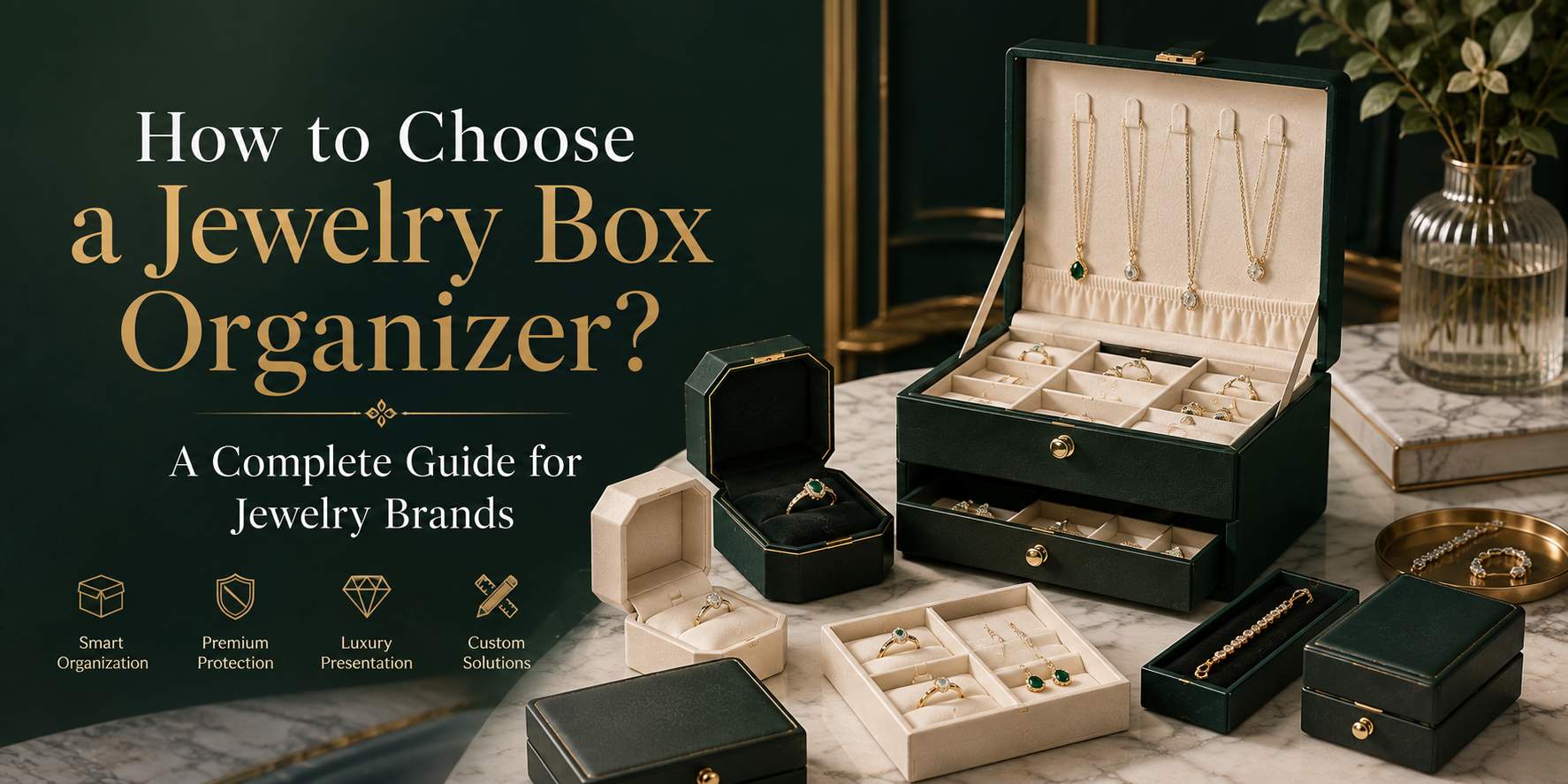
How to Choose a Jewelry Box Organizer?-- A Complete Guide for Jewelry Brands
Aug 31, 2026
A Complete Guide for Jewelry Brands
How do you choose a jewelry box organizer? Start by considering what you need to store, how much space each piece requires, the type of compartments and inserts, the material, and the overall design of the box. For jewelry brands and retailers, a jewelry box organizer should do more than simply keep jewelry separated—it should protect delicate pieces, create an organized presentation, and reinforce the brand's identity.
For businesses, the best solution is often a custom jewelry box organizer designed around specific jewelry products. A well-designed organizer can include dedicated sections for rings, earrings, necklaces, bracelets, watches, or other accessories while allowing brands to customize the box structure, materials, colors, printing, logo finishing, and interior inserts.
Key Takeaways
Choose the organizer according to the type and size of jewelry you sell.
Use separate compartments for rings, earrings, necklaces, bracelets, and watches.
Consider velvet, microfiber, paperboard, foam, or other suitable insert materials.
Make sure the jewelry box provides sufficient protection during storage, retail display, and transportation.
For jewelry brands, custom jewelry boxes can create a more consistent and premium customer experience.
Consider box structure, dimensions, color, logo printing, foil stamping, embossing, and interior design together.
For B2B orders, balance appearance, functionality, durability, MOQ, lead time, and unit cost.
Why Does a Jewelry Box Organizer Matter?
Jewelry is small, delicate, and often valuable. Without proper organization, necklaces can become tangled, earrings can become separated, and rings can easily get scratched or misplaced.
A jewelry box organizer solves these problems by creating dedicated spaces for different types of jewelry.
However, for a jewelry brand, packaging has another important role.
The jewelry box is often the first physical interaction a customer has with the brand after making a purchase. Before the customer sees the jewelry itself, they see the packaging.
A premium jewelry box can therefore influence how customers perceive:
Product quality
Brand positioning
Attention to detail
Gift value
Sustainability
Overall customer experience
This is particularly important for luxury jewelry brands, independent jewelry designers, retailers, e-commerce sellers, and corporate gifting businesses.
Instead of treating the jewelry box as simple storage, brands can use it as part of their jewelry packaging strategy.
Choose the Organizer Based on Your Jewelry Type
The first step is to determine what the jewelry box needs to hold.
Different jewelry products require different interior structures.
Rings
Ring slots or ring rolls are ideal for engagement rings, wedding rings, fashion rings, and other small ring products.
The insert should hold each ring securely without making it difficult for customers to remove the jewelry.
Earrings
Earrings generally need smaller compartments or slots. For stud earrings, dedicated holes or small individual sections can create a clean retail presentation.
Necklaces
Necklaces require special attention because chains can easily become tangled.
A necklace insert can include hooks, slots, or individual sections that keep chains separated.
Bracelets
Bracelets generally require wider compartments than rings or earrings. Depending on the product style, the insert can be designed with individual channels or padded sections.
Watches
Watch packaging usually requires a larger compartment and a supportive cushion. A custom watch and jewelry box can combine watch cushions with additional jewelry compartments.
For brands selling multiple jewelry categories, a multi-compartment jewelry box organizer may provide a more flexible solution
2. Consider the Size and Capacity
A common mistake is choosing a jewelry organizer based only on its appearance.
A beautiful box is not necessarily a functional box.
Before developing a custom jewelry box, consider:
Product dimensions
Number of jewelry pieces
Jewelry thickness
Insert dimensions
Box height
Storage capacity
Shipping dimensions
Retail display requirements
For B2B packaging, it is especially important to test the actual jewelry inside the prototype before mass production.
For example, a box designed for delicate earrings may not have enough depth for a larger pendant. Similarly, a necklace box may look attractive but fail to provide sufficient space to prevent chain tangling.
The best custom jewelry box organizer is designed around the actual product rather than forcing the product into a standard box
3. Choose the Right Interior Material
The interior organizer is just as important as the exterior of the jewelry box.
Different materials can create completely different customer experiences.
Interior Material
Main Advantage
Suitable For
Velvet
Soft and luxurious appearance
Luxury jewelry
Microfiber
Smooth and protective
Fine jewelry
Paperboard
Lightweight and customizable
Retail & e-commerce
Foam
Strong cushioning
Fragile jewelry
Flocked Insert
Premium tactile feel
High-end jewelry
Molded Paper Pulp
More sustainable option
Eco-conscious brands
For premium jewelry packaging, velvet and microfiber are commonly selected because they provide a soft surface and create a luxury presentation.
For brands focusing on sustainability, paper-based inserts or molded fiber solutions can be considered depending on the jewelry design and required level of protection.
The right choice depends on the balance between protection, appearance, cost, sustainability, and brand positioning.
4. Decide Between Standard and Custom Jewelry Boxes
For consumers buying a jewelry organizer for personal use, a standard jewelry storage box may be sufficient.
For businesses, however, customization offers significantly more flexibility.
A custom jewelry box can be developed according to the brand's product dimensions and visual identity.
Customization can include:
Box Structure
Common structures include:
Rigid jewelry boxes
Magnetic closure boxes
Drawer jewelry boxes
Hinged lid boxes
Two-piece rigid boxes
Folding jewelry boxes
Custom-shaped jewelry boxes
Exterior Material
Brands can choose different paper textures and finishes to create different visual impressions.
Options may include:
Matte paper
Textured paper
Specialty paper
Soft-touch paper
Recycled paper
Premium coated paper
Logo and Surface Finishing
Brand identity can be enhanced through:
Gold foil stamping
Silver foil stamping
Embossing
Debossing
Spot UV
Offset printing
CMYK printing
For luxury jewelry brands, a simple logo with subtle gold foil stamping can create a sophisticated appearance without making the packaging feel excessive
5. Think About Color and Brand Identity
Color is another important factor when choosing a jewelry box organizer.
Different colors communicate different brand personalities.
Color Direction
Brand Impression
Black + Gold
Luxury, premium, sophisticated
Emerald Green + Gold
Elegant, distinctive, high-end
White + Gold
Clean, refined, modern
Beige + Brown
Natural, warm, timeless
Soft Pink
Feminine, romantic, fashion-oriented
Navy + Gold
Professional, premium, classic
For B2B customers, the jewelry box should match the existing visual identity of the brand.
A consistent combination of jewelry box color + logo + insert + finishing can make packaging immediately recognizable.
A Practical B2B Example: Designing a Custom Jewelry Box
Consider a jewelry brand preparing to launch a premium necklace collection.
The brand needs packaging that:
Fits one necklace securely
Prevents chain tangling
Looks premium
Includes the brand logo
Works for online orders
Can be produced in larger quantities
Matches the brand's dark green visual identity
A suitable solution could be a rigid paper jewelry box with a custom insert.
The exterior could use a dark green textured paper with subtle gold foil branding. Inside, the box could use a soft microfiber or velvet insert with a dedicated necklace position.
For a B2B manufacturer such as Airetion, the customization process can include structural design, paper selection, printing, surface finishing, insert development, prototype confirmation, and mass production.
Airetion's current production model supports customized paper packaging solutions, with typical MOQs of around 1,000–5,000 pieces depending on the product, while rigid gift box production generally requires around 15–20 days after confirmation, according to the project requirements.
This type of workflow allows brands to develop packaging around the actual jewelry rather than selecting a generic organizer from an existing catalog.
What Should B2B Buyers Ask Before Ordering?
If you are purchasing jewelry boxes for a jewelry brand, retailer, wholesaler, or e-commerce business, ask the packaging supplier the following questions before placing an order:
Can the box be fully customized?
Check whether the supplier can customize the dimensions, structure, paper, printing, finishing, insert, and packaging.
Can you provide a prototype?
A prototype allows you to test the actual jewelry before committing to mass production.
What finishing options are available?
Ask about foil stamping, embossing, debossing, UV printing, specialty papers, and other finishing options.
What is the MOQ?
MOQ can have a major impact on the overall purchasing decision, especially for new jewelry brands.
What is the production lead time?
Confirm the production schedule before planning product launches or seasonal campaigns.
Can the supplier support different box structures?
A supplier capable of producing multiple structures can provide more flexibility as your product line grows.
FAQ: How to Choose a Jewelry Box Organizer?
What is the best material for a jewelry box organizer?
There is no single best material for every jewelry product. Velvet and microfiber are popular for luxury jewelry because they provide a soft and premium surface. Paperboard and molded fiber can be suitable for brands seeking lightweight or more sustainable packaging solutions.
What size jewelry box should I choose?
Choose the size according to the actual dimensions of your jewelry. The box should provide enough room for the jewelry and insert without excessive empty space. For B2B packaging, creating a prototype using the actual jewelry is recommended.
Is a custom jewelry box better than a standard jewelry box?
For jewelry brands, a custom jewelry box generally provides greater control over product fit, branding, interior organization, and customer experience. A standard box may be more appropriate for personal storage or small-scale requirements.
How can I prevent necklaces from tangling inside a jewelry box?
Use dedicated necklace hooks, slots, channels, or individual compartments. The insert should hold the necklace in position and prevent the chain from moving excessively during transportation.
Can jewelry boxes be customized with a logo?
Yes. Depending on the packaging supplier and material, logos can be applied through printing, gold or silver foil stamping, embossing, debossing, and other finishing techniques.
What jewelry box is best for luxury brands?
Luxury brands often choose rigid jewelry boxes with premium paper, textured surfaces, custom inserts, and sophisticated finishing such as gold foil stamping or embossing. However, the final design should match the brand's positioning rather than simply adding more decorative elements.
What should I consider when ordering jewelry boxes in bulk?
Consider MOQ, unit cost, box dimensions, material, insert design, finishing, production lead time, shipping dimensions, quality control, and prototype approval. It is also important to confirm that the supplier can consistently reproduce the approved design during mass production
Final Thoughts: Choose a Jewelry Box Organizer Around Your Product
The best jewelry box organizer is not simply the one that looks beautiful.
It should provide the right combination of organization, protection, presentation, branding, and practicality.
For consumers, a standard jewelry organizer may be enough for everyday storage. For jewelry brands and B2B buyers, however, a custom solution can provide much greater value.
A well-designed custom jewelry box can protect jewelry, organize individual pieces, strengthen brand identity, improve the unboxing experience, and create a more premium impression.
When selecting a packaging supplier, look beyond the box itself. Consider whether the supplier can help you develop the complete packaging solution—from box structure and material selection to custom inserts, printing, finishing, prototyping, and mass production
Looking for Custom Jewelry Boxes for Your Brand?
At Airetion, we specialize in customized paper packaging solutions for international B2B customers. Our capabilities cover custom jewelry boxes, rigid boxes, gift boxes, inserts, printing, gold foil stamping, embossing, and other packaging finishes.
Whether you are launching a new jewelry collection, upgrading your existing packaging, or developing a completely new jewelry packaging concept, our team can help turn your packaging requirements into a production-ready solution.
Your jewelry deserves packaging designed around your brand.
Choose the structure. Choose the material. Choose the finish. Create your custom jewelry box with Airetion.
Contact Airetion today to discuss your custom jewelry packaging requirements and request a packaging solution for your next order.







 IPv6 network supported.